BMW M1 Group 5
The silhouette-formula M1s of 1979–81: March's space-frame car for BMW, Sauber's two space-frame cars, one of which won the 1981 Nürburgring 1000 km, and Schnitzer's twin-turbocharged M1 Turbo of the German championship.
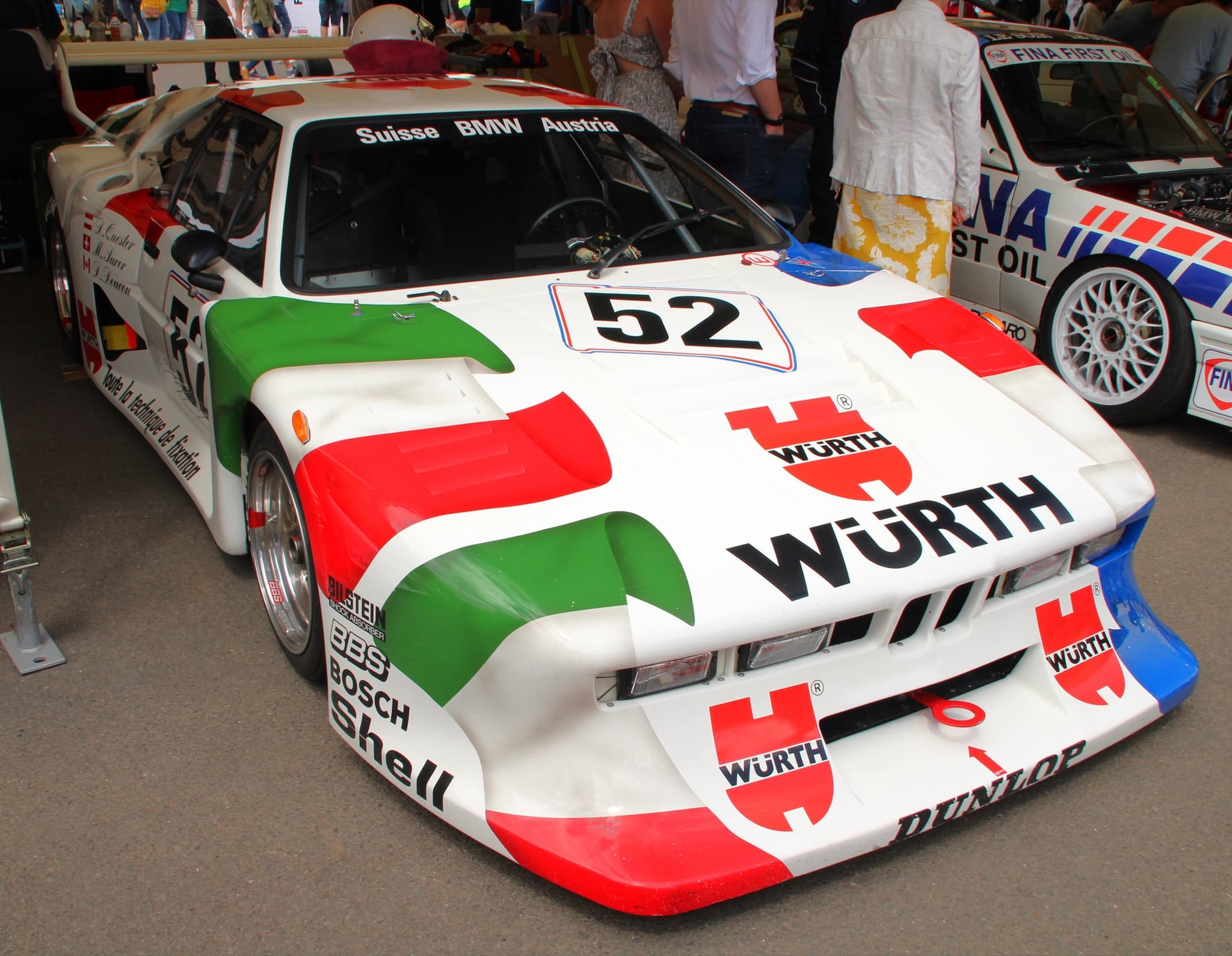
On 24 May 1981 the M1 won its only race in the World Championship for Makes, the Nürburgring 1000 km, in a Group 5 car. Sauber had built it on a space frame of its own, with the normally aspirated six, and GS-Sport ran it in BASF's colours for Hans-Joachim Stuck and Nelson Piquet. Three firms built Group 5 M1s between 1979 and 1981: March, for BMW itself; Sauber; and Schnitzer, whose twin-turbocharged M1 Turbo won twice in the German championship that year.source 1source 2source 3source 4
What Group 5 meant for the M1
Group 5 was the "silhouette" category, so called, Alan Henry explained in Motor Sport, because one of its few rules was that a racing car had to keep the outline of the road car it came from. Roger Bell put it more bluntly: "For silhouette read anything goes, so long as the racer retained the outline and layout of the qualifying homologation specials." Bell wrote that BMW had conceived the M1 to beat Porsche's turbocharged cars in that class. But a Group 5 car had to be derived from one already recognised in Groups 1 to 4, and the M1's Group 4 recognition came only from 1 December 1980, so until then BMW's Group 5 car raced in IMSA's classes, at Le Mans and in the United States. Adam Cooper's summary in 2008 was that "a Group 5 version – which owed little to the original – was also seen".source 5source 6source 7source 8source 9
The March car, 1979–80
BMW's own Group 5 car was planned from the start, and Motor Sport reported the plan in January 1979:
Interesting news was that development of a space-frame Group 5 M1 is at full swing, shared between Robin Herd at March Engineering and Martin Braungart and Paul Rosche at BMW Motorsport. Rosche expects the March-built chassis to be ready before the 3.2-litre, 800 -1,006 b.h.p., turbocharged engine he is working on and a Group 4 engine might be fitted initially.
Stuck was to be its first driver and Le Mans 1980 its "ultimate aim". The car that raced had the normally aspirated M88, and no turbocharged March M1 appears in any result read. racingsportscars records a "BMW March M1" as a reserve entry at Le Mans in June 1979. In February 1980 two March-BMW M1s started the Daytona 24 Hours, one entered by March Engineering and one by Jim Busby, and both stopped with broken drive shafts. Busby's car ran again at Sebring in March, where its gearbox (transmission) failed, and at Riverside in April, recorded there with a Chevrolet engine. At Le Mans in June 1980 March Engines entered No. 82 for a crew that included Manfred Winkelhock, and it went out after an accident on lap 38.
The Le Mans records give its chassis as 002 in 1979 and 002a in 1980, and with two cars at Daytona there were at least two. How many March built, no source read says. March's next car for BMW North America, the M1/C of 1981, was a March of its own design, and the M1 race car follows it.source 3source 1source 10
Schnitzer's M1 Turbo, 1981
Schnitzer built the M1 that came nearest to BMW's turbocharged plan, and raced it in the German championship's first division in 1981, entered at first as the Lubrifilm Schnitzer BMW Team. touringcarracing calls it the only new challenger of that season, and sums it up:
The German championship struggled on, and in its final season we saw a car which should have been there from the beginning: a BMW M1 Turbo. But it was too late and underfinanced, though it was an interesting car to say the least.
touringcarracing gives its specification: a BMW straight six with a smaller bore than the road engine's and the same stroke, 3,150 cc in all, with two overhead camshafts, four valves per cylinder and two KKK turbochargers; a Hewland or ZF four-speed gearbox; wheels of 13 × 16 inches in front and 15 × 19 at the rear; and a weight of 1,065 kg (2,348 lb). BMW described Schnitzer's car in 2008 as having "a kevlar body".
The power is a matter of whose figure. No source read gives one figure for "the Group 5 M1", and each claim below belongs to its own car and kind:
| Claim | Car and kind | Source |
|---|---|---|
| 800 hp at 8,000 rpm | Schnitzer's M1 Turbo, 1981 | touringcarracing |
| "nearly 1,000 PS" | Schnitzer's M1 Turbo in practice, 1981 | Slickpix, 2024 |
| up to 850 bhp | BMW's Group 5 technical description, no car named | BMW, 2008 |
| "up to 1000bhp with twin turbochargers" | the six's potential, a writer's estimate | Roger Bell, 1997 |
Stuck drove it, as No. 51, in a season short of money:
| Date | Race | Result |
|---|---|---|
| 29 March 1981 | Nürburgring 300 km | 3rd |
| 26 April 1981 | Eifelrennen, Nürburgring | 3rd |
| 21 June 1981 | Wunstorf | did not start |
| 28 June 1981 | Norisring | 1st in Division 1 |
| 12 July 1981 | Salzburgring | 1st in Division 1 |
| 1 August 1981 | Hockenheim, German Grand Prix meeting | 2nd |
| 23 August 1981 | Zolder | 4th |
It retired at Zolder in March, at Hockenheim in April, at Mainz-Finthen in May and at the Nürburgring Supersprint in September. At Wunstorf it was scratched because its sponsor, Lubrifilm, had refused to pay the bills. A week later, at the Norisring, Wollek's Porsche ran out of fuel 3 laps from the end while Stuck, unsure of his own fuel, kept going, and touringcarracing recorded the mood: "the team was ecstatic; a fine revenge to sponsor Lubrifilm, who had stopped paying weeks ago and whose decals were removed from the car." At the Salzburgring Stuck took pole and fastest lap and won in the rain, the gearbox stuck in fifth late in the race. At Hockenheim only Manfred Winkelhock's Capri beat him.
Schnitzer ran a second M1 in 1981, serial 4301072, a former Procar, which was seventh at the Norisring; whether it was a turbo, no source read records. Nor does any source read say whether the Schnitzer M1 that Stuck drove to four wins in German races in 1982 was the same turbo car.source 4source 11source 12source 3source 6source 7source 13source 14
Sauber's Group 5 M1s, 1981
Sauber built two space-frame Group 5 M1s, which racingsportscars records as 81.M1R.01 and 81.M1R.02. They kept the normally aspirated six of the Procar, with Kugelfischer injection and a ZF five-speed gearbox, ran on Dunlop tyres and, by Slickpix's account, had aramid (Kevlar) bodies.
81.M1R.02 was GS-Sport's car in BASF colours. At the Nürburgring on 24 May 1981 Stuck and Piquet led when the race was stopped after 17 of its 44 laps. Stuck remembered the car and the day in 2011:
I raced a special spaceframe M1 with Nelson Piquet in the '81 Nürburgring 1000Kms, and we were leading when it was stopped by poor Herbie Müller's fatal accident.
The rest of its season was harder. At Le Mans, with Jarier, Stuck and Helmut Henzler, it went out after 57 laps with accident damage, and at the Brands Hatch 1000 km Stuck and Heyer crashed out. In the German championship GS-Sport entered it for Piquet at the Norisring, where he did not start the championship race, and for Christian Danner, who was sixth at Hockenheim and third at Zolder; only the Zolder entry carries the chassis number. In the Kyalami 9 Hours on 7 November 1981 Stuck crashed at night: "I hit the wall at 250kph … The car broke in half," he told Motor Sport in 2011.
81.M1R.01 was Sauber's own, in the colours of Würth and Lubrifilm. Marc Surer and Dieter Quester were 13th with it at the Nürburgring in May, and at Le Mans its engine failed after 207 laps. It raced on for others: BMW Italia were third with it in the Nürburgring 1000 km of 1982, and Enzo Calderari won a Swiss championship race at Dijon in April 1982 and, with Marco Vanoli, the Hockenheim 3 Hours on 29 October 1983. The car on this page's cover is in that car's Le Mans livery of 1981.source 1source 12source 4source 15source 13
Other Group 5 M1s
Procars ran under Group 5 rules too, as entries more than as new cars. EMKA's car, 4301028, which Niki Lauda had raced in Procar, ran in Group 5 at Le Mans in 1981 and won the class for cars over 2 litres at the Brands Hatch 1000 km that year. BMW Italie-France's No. 51 was fifth in Group 5 at Le Mans in 1981, Total's 4301059 third in the class at Le Mans in 1982, and BMW Motorsport entered 4301269 as an "M1 Gr.5" at Mosport in 1981, where it was 14th. The Register marks all three serials PROCAR.source 1source 16
Specification
Production
Sources for Production, Group 5
- Built
- One good source.The March car at Le Mans in 1979 and 1980; the Sauber cars in 1981. racingsportscars.com, Race, results and car-data pages with BMW M1 entries, 1979–86 (group)source 1
| Built | 1979–1981 |
|---|
Engine
Sources for Engine, Group 5
- Engine position
- One good source.Roger Bell, "Discovering BMW's lost leader", Motor Sport, Jul 1997, p. 88source 6
| Engine position | Mid |
|---|
Running gear
Sources for Running gear, Group 5
- Layout
- One good source.Roger Bell, "Discovering BMW's lost leader", Motor Sport, Jul 1997, p. 88source 6
| Layout | RWD |
|---|
Body and chassis
Sources for Body and chassis, Group 5
- Body
- One good source.Roger Bell, "Discovering BMW's lost leader", Motor Sport, Jul 1997, p. 88source 6
| Body | Coupe |
|---|
Sources
Sources are given as plain text; their addresses are on the sources page.
- Primarymade at the time, by the maker or by people who were there
- Referenceserious later work: clubs, specialists, magazines, books
- Databaseresults and listings, entry by entry
- racingsportscars.com, Race, results and car-data pages with BMW M1 entries, 1979–86 (group), Nürburgring 1000 km, 24 May 1981: No. 12, "BMW M1 Sauber", chassis 81.M1R.02, BASF Cassetten/Team GS-Sport; Le Mans 1979 and 1980 (results and car data); Daytona 24 Hours, Sebring 12 Hours and Riverside, 1980; Nürburgring 1000 km 1981; Le Mans 1981 (results and car data); Silverstone 6 Hours and Brands Hatch 1000 km 1981; Le Mans 1981 and 1982; Brands Hatch 1000 km 1981; Mosport 1981; Le Mans 1979–81 entry and data pages. Database
- Motor Sport, "Hans on…", Nov 2006, p. 58, p. 58, the win. Reference
- Clive Richardson ("C.R."), "BMW's Racing Plans", Motor Sport, Jan 1979, p. 54, p. 54, the March Group 5 project; p. 54, the plan and the quotation; p. 54, Rosche's planned turbo engine. Primary
- touringcarracing.net, Season car pages, "1978 Cars" to "1981 Cars" (group), "1981 Cars": the Schnitzer M1 Turbo and the Sauber M1; "1981 Cars", BMW M1 Turbo, Schnitzer: engine, turbochargers, power, weight, gearbox, wheels; "1981 Cars", BMW M1 Sauber. Database
- Alan Henry, "Procar: When current F1 champs went tin-top racing" ("Procar – the ultimate one-make racer"), Motor Sport, Jul 1997, p. 94, p. 94, the "silhouette" category. Reference
- Roger Bell, "Discovering BMW's lost leader", Motor Sport, Jul 1997, p. 88, p. 88, "For silhouette read anything goes"; the M1 conceived to beat Porsche; p. 88, "up to 1000bhp with twin turbochargers"; p. 88. Reference
- BMW AG (BMW Group PressClub USA), "Icons for Connoisseurs – Thirty Years of the BMW M1" (press release), 27 Mar 2008, the Group 5 rule; the target of Group 4 and Group 5; "Technical Description BMW M1 Group five"; the Kevlar body. Primary
- ONS / FIA (FIA Historic Database), ONS/FIA homologation form (Testblatt) no. 670, BMW M 1, Group 4 (and its transfer to Group B), 1980, form p. 1, Group 4 from 1 December 1980. Primary
- Adam Cooper, "One for the pros", Motor Sport, Oct 2008, p. 54, p. 54, "a Group 5 version – which owed little to the original". Reference
- International Motor Racing Research Center (racingarchives.org), from Octane Press, IMSA 1969–1989 (excerpt, "BMW"), the March M1/C that followed. Reference
- touringcarracing.net, DRM 1981: race pages and "1981 DRM Class" (group), Wunstorf, Norisring, Salzburgring and Hockenheim, 1981: results, the Lubrifilm story and the quotation. Database
- racingsportscars.com, "BMW M1 – All Results", Stuck's 1981 DRM entries, No. 51; the second Schnitzer M1, 4301072; the entries of 81.M1R.01 and 81.M1R.02, 1981–86; the Norisring, Hockenheim and Zolder entries of 1981. Database
- Erich Kahnt, "The BMW M1 – Swiss Made!", Slickpix (first published in Curbs magazine), 29 Nov 2024, the Schnitzer turbo under a Kevlar body; the Sauber cars' aramid (Kevlar) bodies. Reference
- touringcarracing.net, Deutsche Rennsport Meisterschaft season texts, 1979–1981, 1981: "the only new challenger"; the quotation. Database
- Simon Taylor, "Lunch with… Hans Stuck", Motor Sport, Dec 2011, p. 89, p. 89, the quotation; the Kyalami crash. Reference
- BMW M1 Register, "VIN Table", the PROCAR marks of 4301028, 4301059 and 4301269. Reference