BMW M1 Review
How the BMW M1 was received and what the testers found: the Paris launch of 1978, the German test of 1979 as BMW later reported it, Motor Sport's road tests of 1981 and 1984, the Grand Prix press on Procar, and the drives of later years.
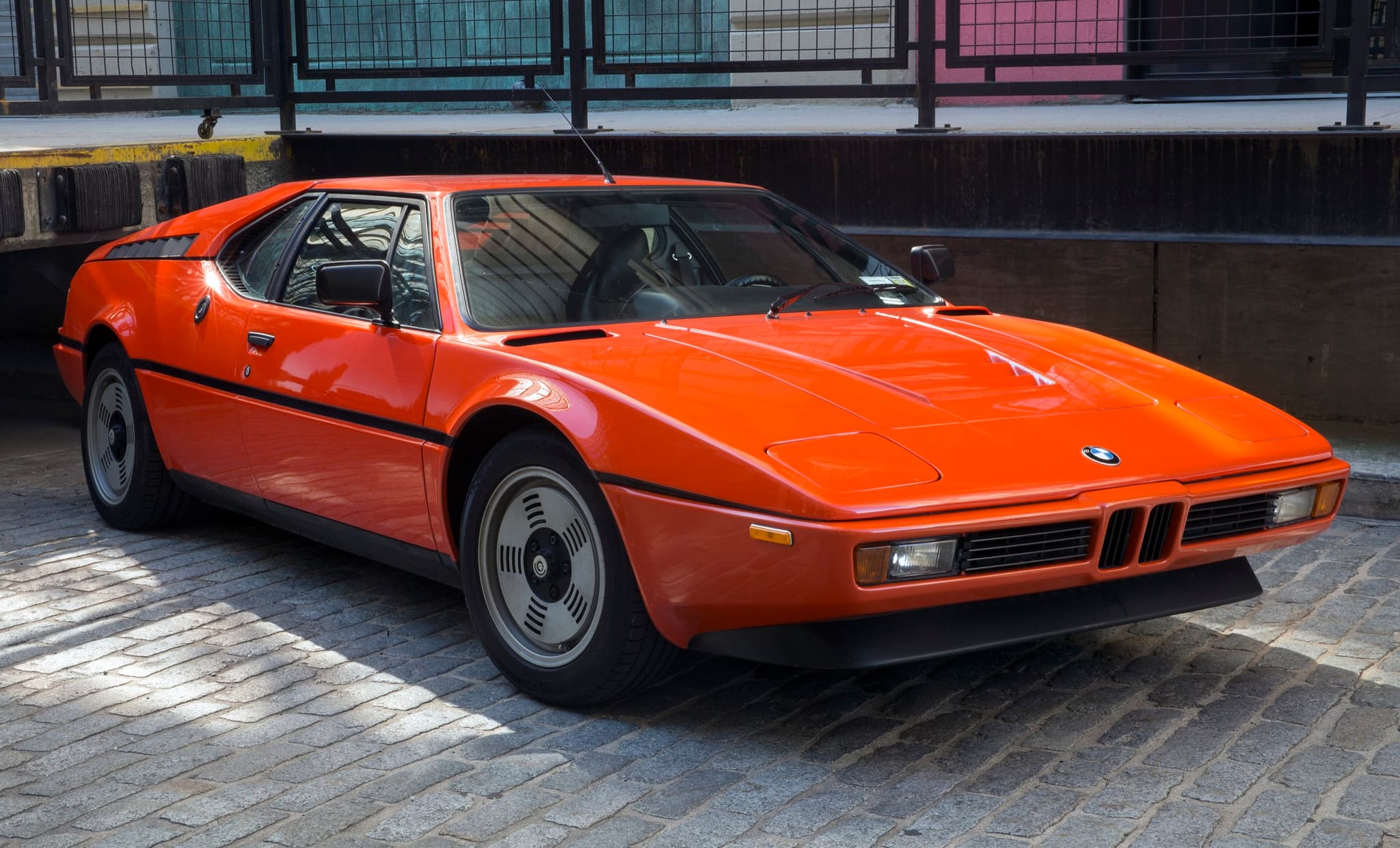
Jeremy Walton collected a red M1 in Munich one winter's day for Motor Sport and drove it through the city's traffic, onto a snowy autobahn and over ice to Oberammergau and Garmisch-Partenkirchen, coming back by way of Buchloe, on Goodyear tyres in place of its Pirellis. His report, printed in April 1981, is the fullest period test of the road car among those read. The German tests of the time reach us mostly through BMW's later account, and the other British test is Motor Sport's again, by A.H. in 1984.source 1source 2source 3
Paris, 1978
When BMW looked back in 2008 on the Paris Motor Show of October 1978, it quoted the press of the time on the scene at its stand, without naming the papers: "Everybody was crowding around BMW's new mid-engined sports car", and that "The list of orders coming in exceeds even the wildest expectations", one American fan having already ordered three. The racing plan had a cooler reception. When Motor Sport reported BMW's press conference of December 1978, it noted that Procar was "going ahead at full steam despite the cynicism from some quarters at the time of the original announcement". Motor Sport's buying guide of 2021 says the car itself drew "rave reviews".source 3source 4source 5
The German test of 1979
The first German test was Götz Leyrer's in auto motor und sport at the end of 1978, known today through BMW Group Classic's own account of it: he was impressed by a practicality rare in the class, by the air conditioning and a usable boot (trunk), and by cornering of almost 1 g, and BMW's English version has him write that "there was probably no other car on the road that could live with it through the twisty stuff".
In 2008 BMW recalled a test by "Germany's leading car magazine" in the autumn of 1979, which recorded the top speed that the specifications give as measured, and it quoted the tester in English, without his name:
Once the throttle butterflies are fully open you feel a tremendous kick from behind continuing well beyond the 200 km/h-mark. There is no need to shift to fifth gear, for example, until you reach a speed of 213 km/h (132 mph) and from there you continue to accelerate up and up to the car's top speed.
BMW's account also gives a time to 100 km/h without making clear whether the magazine timed it or it was BMW's own claim, which the auto katalog 1980 had printed among the maker's figures.
Motor Sport, April 1981
Walton found a car he could use: "It is, above all, a practical everyday machine, not a Stratos-style homologation special." It was, he wrote, "A true driver's car rather than a poser for Monaco". It was stable in crosswinds and kindly on ice, its tail easily caught; the gearchange and the steering pleased him, and so did the fit and finish of the glass-fibre body. His summing up went further:
I would guess, and without driving all the current top car crop it can only be a guess, that this is the safest and most exploitable of supercars to emerge since the era of true GTs with front engines and rear drive.
His one serious complaint came from the weather: "The only severe problem encountered was the incompatibility of the powerful single wiper and the vast quantities of salt and slush we met." He was also writing about a car that was already rare, with no right-hand-drive version and no official British import, and he drew the conclusion: "So the LHD-only M1 has perforce become an instant collector's piece." He had read the other reports too: "We have yet to encounter, or read a report, by anyone who did not think the M1 was a true super car." Owners used to a Porsche Turbo or a Jaguar XJ-S, he warned, would find the engine loud on long runs at about 210 km/h (130 mph), and he argued that each M1 had cost BMW far more than its price, after Procar and the change in how the car was built. He ended on a wish: that BMW would stay with two-seat sports cars, perhaps with "something smaller to wear a 328 badge". In the United States, where the car was never officially sold, Road & Track gave it a special award of its own in its 10 Best of August 1981: "Most Desirable Unobtainable".source 1source 9source 10
Motor Sport, December 1984
A.H. had driven a Procar in the wet at Donington during the summer of 1979, and in 1984 he drove a road car in Britain, one of the few there. He found Giugiaro's shape still crisp after 6 years, and wrote:
Undeniably attractive and engineered to an impressively high standard, the M1 was certainly no homologation special in road form: it was built to the same stringent levels of quality as any other production BMW and this alone marks it out as somewhat unusual amongst "small run" machines
The breakaway in the wet was progressive and the car was stable at speed; his reservations were the headroom, the view out and a trace of lightness in the steering. He thought the M1 obsolete before the last cars were built, but a classic from the start, and he believed that had BMW kept developing it as a flagship for its range, it might have been counted among the best sports cars in the world.source 2
The Grand Prix press and Procar
The warmth of the road testers did not reach the Grands Prix, where the M1 arrived as Procar, a one-make series run alongside them. Denis Jenkinson, writing after the first race, at Zolder in May 1979, counted 19 entries, 17 starters and seven finishers, "not very good publicity for BMW with broken-down M1 coupés all round the circuit", and passed on Ken Tyrrell's view that if BMW wanted Formula 1's publicity, it should build a Formula 1 car and take part. Monaco, a fortnight later, "went off a lot better than it did in Belgium", Jenkinson allowed, with Lauda and Regazzoni wheel to wheel. The magazine's report from Zandvoort in August was dry about it: Lauda hurt his wrist practising his M1 for the Procar race, which gave him "the excuse to stop driving the Brabham-Alfa Romeo V12" in the Grand Prix. In September the same magazine's report of the Austrian Grand Prix gave the Procar race a line: it ran after Saturday's practice, "with the usual mixture of Grand Prix drivers and 'local lads'". Later writers remembered the series more warmly. BMW, in 2008, called the races "just as popular as the ensuing races for the Formula 1 World Championship", and Heseltine, the same year, called the series "a smash in every sense". The Procar Championship follows the races.source 11source 12source 13source 14source 3source 15
What the testers measured
The tests that can be read today give these figures; the specifications give BMW's own, and the top speed measured in 1979.source 3source 1source 16source 2
| Test | Date | Car | Measured or observed |
|---|---|---|---|
| A tester of "Germany's leading car magazine", as BMW reported it | autumn 1979 | not identified | the top speed the specifications give as measured; fifth gear needed only from 213 km/h (132 mph) |
| Jeremy Walton, Motor Sport | April 1981 | a red road car on Goodyear NCT tyres, in winter | 255 km/h (158 mph), a two-way average in fifth; 199 km/h (124 mph) indicated in fourth; about 17 litres per 100 km (16½ mpg, imperial) driven hard |
| Motor, as Roger Bell reported it in 1997 | not given | not identified | about 259 km/h (161 mph), a two-way maximum; from rest to 161 km/h (100 mph) in 13 seconds |
| A.H., Motor Sport | December 1984 | a road car in Britain | about 116 km/h (72 mph) in second and just under 161 km/h (100 mph) in third; 60 mph in about 7 seconds, by his impression |
Praise and complaints
The testers praised the build quality (Walton, A.H. and Heseltine, who thought the even shut lines a first for a supercar), the ease of the car in traffic and its stability at speed. They complained of the headroom, the pedals pushed towards the middle by the wheel arch, the view behind and the plain trim, and they disagreed about the clutch. The interior and the buyers guide take each point in turn.source 1source 2source 16source 15
Later drives
For the car's 30th anniversary, in 2008, Richard Heseltine drove one for Motor Sport and found that "For what is essentially a track weapon, piloting an M1 is near-effortless." The handling pleased him and the cabin did not, but his verdict was plain:
This is, however, an absolute jewel of a car.
Roger Bell had driven BMW (GB)'s own red car in Wales for the same magazine in 1997, and his verdict is told in the history. Motor Sport's buying guide of 2021 called the M1 "certainly the most influential" of BMW's M cars, though neither the first nor the most successful. In South Africa in 2016 Brenwin Naidu of TimesLIVE found it "The perfect antidote to those who opine that cars are too clinical and too inert in 2016", and in 2020 Shane O'Donoghue drove one of BMW's own early cars for completecar.ie and found that "Given its original supercar billing, it feels remarkably docile and normal, actually." On film, the Number 27 channel's presenter drove a road car on English moorland roads in 2023 and came away with the impression of a German car under Italian clothes; his drive takes in the offset pedals, BMW's switchgear, the gearchange and the steering, and the ride of a car on rebuilt Bilstein dampers.source 15source 16source 5source 17source 18
Sources
Sources are given as plain text; their addresses are on the sources page.
- Primarymade at the time, by the maker or by people who were there
- Referenceserious later work: clubs, specialists, magazines, books
- Uncheckedencyclopaedias and enthusiast sites: cited beside a good source, named in the sentence, or marked Unchecked
- Jeremy Walton ("J.W."), "Road Impressions: BMW M1", Motor Sport, Apr 1981, p. 83, p. 83, the route and the car; pp. 83 on: the drive, the verdicts and the quotations; p. 83, the measured run, the speeds in the gears and the fuel used; p. 83. Primary
- Alan Henry ("A.H."), "M1 Magic", Motor Sport, Dec 1984, p. 76, p. 76; p. 76: the drive, the Procar at Donington, the verdicts and the quotation; p. 76, the speeds in second and third, and 60 mph. Primary
- BMW AG (BMW Group PressClub USA), "Icons for Connoisseurs – Thirty Years of the BMW M1" (press release), 27 Mar 2008, the German test of autumn 1979; the Paris show and the press of 1978 as BMW quoted it in 2008; the section on the speed recorded in autumn 1979, the quotation; the acceleration sentence; the Procar races remembered. Primary
- Clive Richardson ("C.R."), "BMW's Racing Plans", Motor Sport, Jan 1979, p. 54, p. 54, "the cynicism from some quarters". Primary
- Motor Sport, "BMW M1: road car buying guide", Oct 2021, p. 145, p. 145, "rave reviews"; p. 145, the verdict. Unchecked
- auto motor und sport, auto katalog 1980, Ausgabe Nr. 23 (Stuttgart, 1979), pp. 196–197, BMW's own figures. Primary
- BMW Group Classic, "A letter from the sporting gods" (BMW Classic blog), Götz Leyrer's test in auto motor und sport 25/1978, the quotation in BMW's English. Primary
- Wikipedia (German), BMW M1, the performance section: the auto motor und sport figures of 1986 (attributed). Unchecked
- Road & Track, Road & Track, index to volume 33 (1981), 1981, "BMW M1, 'Most Desirable Unobtainable' special award", 10 Best, August 1981, p. 40. Primary
- Hagerty Drivers Foundation (National Historic Vehicle Register), "1979 BMW M1 Art Car No. 4, Andy Warhol", never officially sold in the United States. Reference
- Denis Jenkinson, "Reflections in the Woods", Motor Sport, Jun 1979, the Zolder race: entries, starters and finishers; Ken Tyrrell's objection. Primary
- Denis Jenkinson, "Reflections in the Builder's Dust", Motor Sport, Jul 1979, p. 99, p. 99, the Monaco Procar race. Primary
- Denis Jenkinson, "Dutch Grand Prix", Motor Sport, October 1979, p. 75, Lauda's wrist. Primary
- Motor Sport, "1979 Austrian Grand Prix race report", Sep 1979, p. 29, p. 29, the Procar race after Saturday practice. Primary
- Richard Heseltine, "BMW M1", Motor Sport, Mar 2008, p. 134, p. 134, Procar remembered; p. 134, the shut lines; p. 134, the drive; the quotation. Reference
- Roger Bell, "Discovering BMW's lost leader", Motor Sport, Jul 1997, p. 88, p. 88, Motor's figures; p. 88; p. 88, the drive in Wales. Reference
- Brenwin Naidu, "Classic Review: 1978 BMW M1 (E26)", TimesLIVE, 11 Nov 2016, the drive and the verdict. Reference
- Shane O'Donoghue, "2020 BMW M1 (1978) review", completecar.ie, 24 Jan 2020, the drive and the verdict. Reference